


We can't let you onboard just yet, but you can explore a sample module below to get a feel for how FEAST looks, sounds, and works.
LAY OF THE LAND
How FEAST is Structured
Every weekly lesson in FEAST follows the same general structure. Like toddlers, freelancers thrive on routine. So that’s exactly what we’re giving ya. And maybe some apple juice if you behave. We'll see. Here’s how each week is laid out:
Mission Briefing
A short video intro from whoever is hosting that week's lesson to set the mood and get you in gear. That's Andrea Dottling, Parker Grant, or Meghan Traynor.
Main Module
This is the core lesson for the week. It’s where we break down the strategy and give you practical tools you can apply immediately.
Captain's Log
A short, diary-style entry from that week’s host. This is where we share a real story or perspective to connect the lesson to lived experience.
Resource Bay
A curated collection of extra goodies for the week. Articles, tools, videos, downloads, and links that deepen the topic without overwhelming you.

Field Assignment
This is where you put the lesson into action. Each week includes a focused task designed to move your business forward in a tangible way.
Systems Check
A short quiz to reinforce what you’ve learned. Don't worry, you won't be graded or judged by a panel. It's just a quick calibration before you move on.

Signal Boost
This is your space to share and connect with other FEAST cadets. Post your progress, ask questions, and see what others are building alongside you.
Mission Control Live!
Our weekly live session, where we dive deeper into that week’s topic. Get feedback and your questions answered in real time. Plus, human interaction! Wow!
LOOK INSIDE
Week 11: How to Build a Sales Funnel
This is the "Main Module" part of Week 11, aka the main lesson. We can't share the entire thing, but here's a pretty juicy-sized sneak peek of what's inside.

A Few Thoughts
If you’ve never heard of a sales funnel before, don’t feel weird about it.
We didn’t know what it was when we first started IDLance! As it turned out, we were accidentally doing half of it already, just not in an organized way. Chances are, you’re doing pieces of it too! We’re going to explore sales funnels more deeply later in this lesson, but at a super high level, it’s just the path someone takes from having no clue who you are to wanting to work with you.
It's a simple way to map out how people discover you, get to know your work, and eventually decide to hire you.
To put it another way, it’s like leading a potential client through a Home Alone house of booby traps to get them right where ya want them–trapped in the treehouse. We mean…in your client portfolio. Oh, and in this case, “booby traps” are actually “charming touchpoints” and not paint cans to the face. Never slam a potential client in the face with a can of paint. That’s very important.
Ok, let’s put the fun back in funnel and get this week’s lesson started!
Mission Objectives
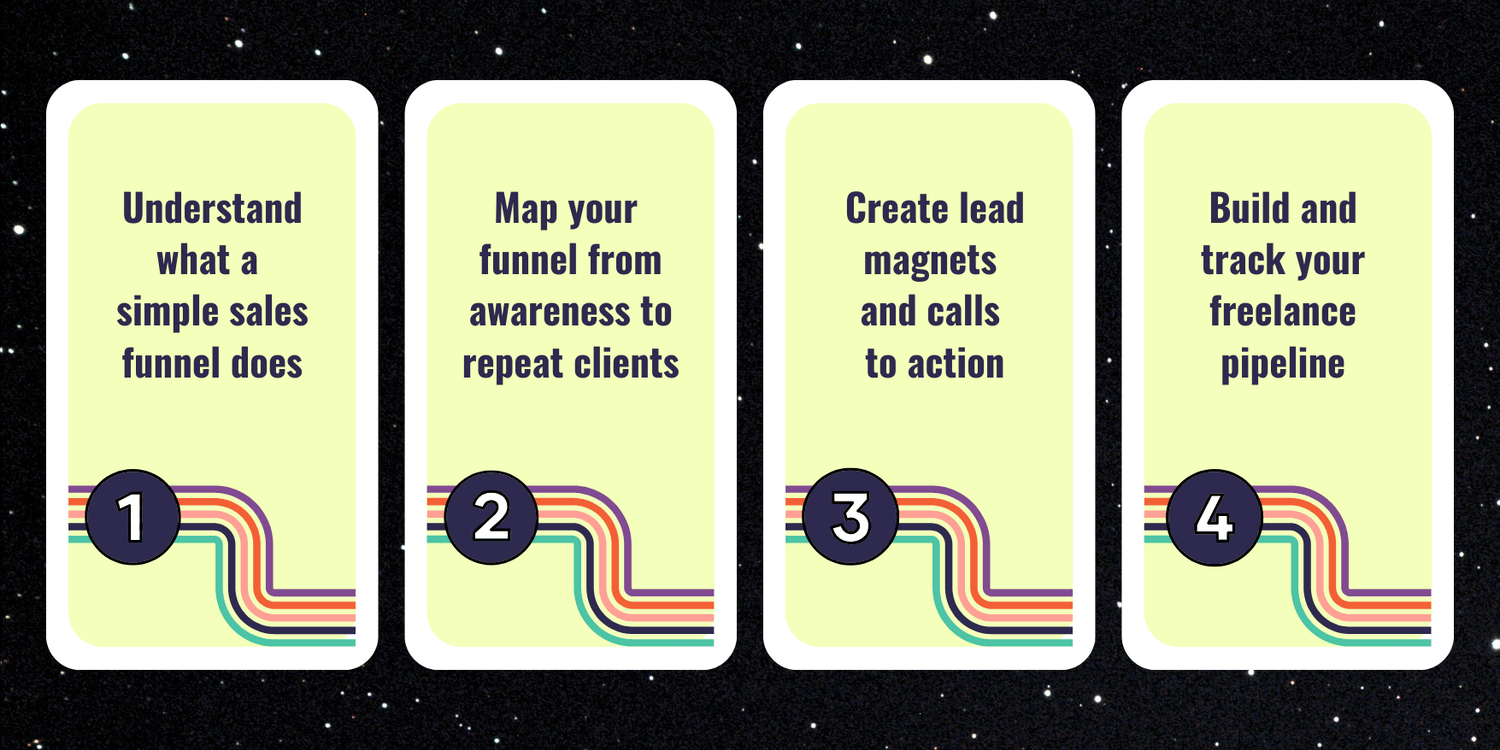
Understand what a simple sales funnel does.
Map your funnel from awareness to repeat clients.
Create lead magnets and calls to action.
Build and track your freelance pipeline.
Plug Up Your Leaks
Let’s start things off with a good old-fashioned metaphor!
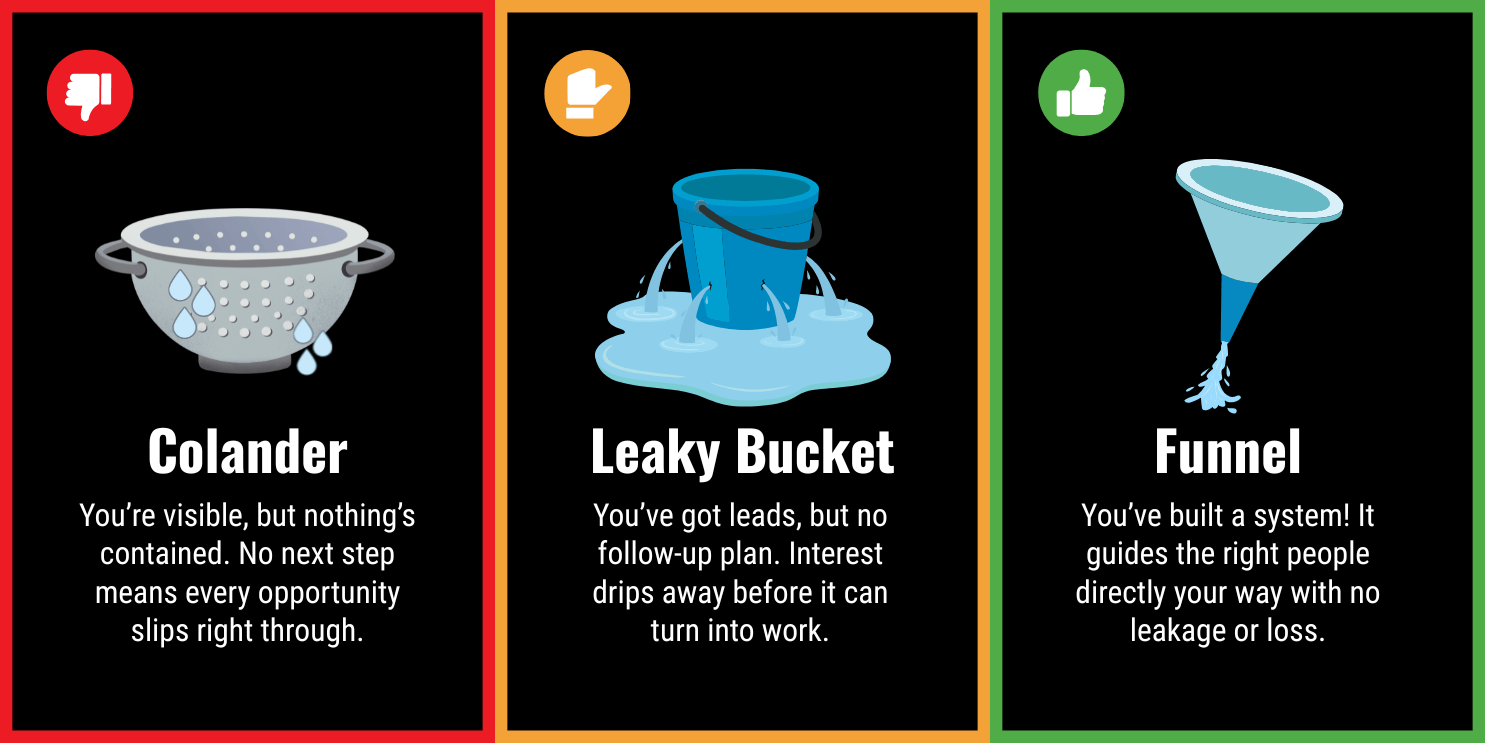
Imagine you’re in your kitchen. You’ve got a colander, a leaky bucket, and a funnel. All three are designed to move stuff from one place to another, but only one actually works the way we want a sales funnel to work.
Can you guess which one it is? You’re never ever ever going to guess.
The Colander
A colander is great for pasta, terrible for business. This is what it looks like when you’re visible but not actually capturing anything. Maybe people are liking your posts. Maybe a stranger DMs you saying, “Love your work!” Maybe a friend-of-a-friend says they want to chat sometime.
And then… nothing. They slip right through because there’s no “next step” for them to take. We lizard-brained humans always need a next step, or we end up mindlessly walking in circles and bumping into walls.
It might look like:
Someone comments, “Wow, this is fantastic work!” and instead of guiding them anywhere, like a website, portfolio, or contact form, you just reply OMG, thanks!!” and go about your day. That potential opportunity drains right into the sink.
That’s colander energy. No one wants colander energy. Plus, they’re so hard to clean. No thanks! Don’t be a colander.
The Leaky Bucket
Next up! A leaky bucket.
Maybe some adorable mice chewed through the bottom, or you use it to prank your Grampy every Thanksgiving. That’s all well and good, but we’re still not quite where we want to be.
But we’re getting closer! You have leads, you’re just not holding onto them for long.
A leaky bucket shows up when you don’t have a follow-up rhythm. People reach out, you talk once, maybe even get excited, and then it evaporates because life happens, and there’s no structure to keep the conversation alive.
Unlike a colander, you are catching some stuff, but it’s slipping out before it can turn into anything real.
It might look like:
You have a great discovery call with someone new. The potential client says, “Can you send over your services, rates, or a quick overview of how you work?” And suddenly you’re thinking:
“Uhhh… I don’t have that written out yet.”
“What is my process, actually?”
“Do I even have a portfolio link that isn’t from 2019?”
So instead of sending something confidently within a few hours, you spend days trying to whip together materials, overthinking every sentence, rewriting your bio 14 times, and second-guessing what to say.
By the time you finally hit send, the spark has dimmed. The bloom is off the rose! Not because you’re flaky, but because you didn’t have a smooth, ready-to-go way to keep the conversation moving.
That’s the leaky bucket. The interest is there, but the structure to capture it…not so much.
The Funnel
If you didn’t guess already, the funnel is what we want to emulate in our sales process. We know, you didn’t see that one coming. We love to keep you guys on your toes like that.
A funnel works because it guides people step-by-step instead of leaving them to wander around hoping they’ll magically hire you. No leaks, no confusion, no psychic abilities required!
Unlike the colander (no container) or the leaky bucket (no structure), a funnel has intentional steps stacked in the right order. Each step gently ushers someone forward, giving them more clarity, trust, and information as they go.
It might look like:
Someone sees one of your posts on LinkedIn → clicks to your website → browses your services → fills out your inquiry form → gets your beautiful pre-written follow-up email → books a discovery call → and by the time they meet you, they already understand what you offer and how you work.
Suddenly, it feels easy because the system is doing a lot of the heavy lifting for you.
That’s the magic of a funnel! You’re not chasing people or scrambling for documents. And there’s no luck involved. You’re simply giving people a clear, frictionless journey right to your metaphorical treehouse — we mean… your client portfolio.
Always aim for full funnel energy.
(Insert a buncha other good stuff about funnels and lead magnets here. Sorry, can't share it all!)
How to Build a Sales Pipeline
We just finished talking about funnels, and now we’ve gotta talk about PIPELINES, what?! Could it be any more confusing??
Ok, it’s actually not that bad if you think of it this way…
...Your sales pipeline is like a pizza tracker.
You know how, when you order a pizza, you can watch it move through each stage?
We got your order!
We’re prepping your pizza!
It’s in the oven!
It’s on the way!
It’s delivered! All your life’s problems are solved!
A pipeline works the exact same way, just with clients instead of carbs. Your funnel shows the big-picture journey a lead takes as they move closer to hiring you. But your pipeline is your internal tracker showing where each potential project is and what you need to do next to keep things moving. One’s a system (funnel), and one’s a tracker (pipeline). Get it?
Instead of “your pizza is being boxed,” it’s “your lead is in discovery.”
Instead of “the driver is on the road,” it’s “your proposal is being reviewed.”
Instead of “your pizza has arrived,” it’s “the contract is signed—HURRAH!!”
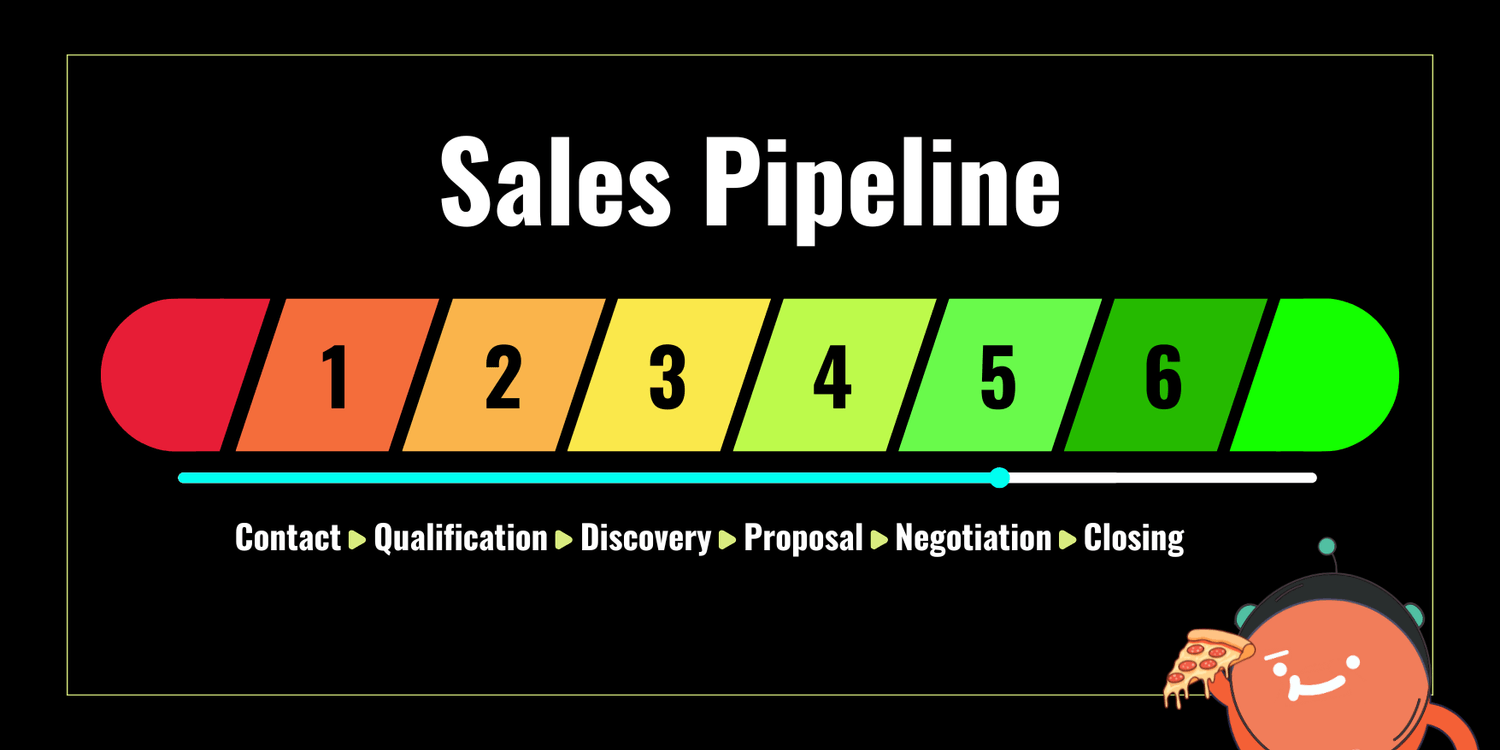
Your sales pipeline helps you:
Assess all your potential projects at a glance
Understand which ones need attention
Identify where things tend to stall in your funnel
Avoid losing track of warm opportunities
Move people steadily toward “Client: Delivered!
Where Your Pipeline Should Live
So, where do you actually stick this thing?
Your pipeline does not have to be a complicated CRM or a color-coded Notion empire with 47 automations and a widget that tells you the moon phase. But that sounds awesome! You can build a perfectly functional pipeline using:
Google Sheets
Excel
Trello (fancy)
ClickUp (fancier)
In our humble opinion, a simple spreadsheet works totally fine. Most freelancers start there and stay there forever because it’s easy, searchable, and takes ten minutes to update.
Do you need a pipeline?
Short answer: No.
Longer answer: Also no, but… kinda yes.
You won’t implode without one. You won’t be shunned by Parker or forced to live among the colander people. But you may have less juicy data on the health of your sales process.
A simple starter pipeline (feel free to steal this):
Create a sheet with columns for:
Name / Company
Lead Source (LinkedIn, referral, cold outreach…)
Stage (Contact, Qualification, Discovery, Proposal, Negotiation, Closing)
Next Step
Likelihood to Close
Notes
Boom! You now have a functioning pizza tracker…erm, sales tracker…for your business.
It doesn’t have to be pretty, so don’t spend too much time on it. All that really matters is that it makes sense to you and the way you think. And over time, you can always upgrade it into something more robust, but starting super simple makes it far more likely you’ll use it.
It might look something like this:
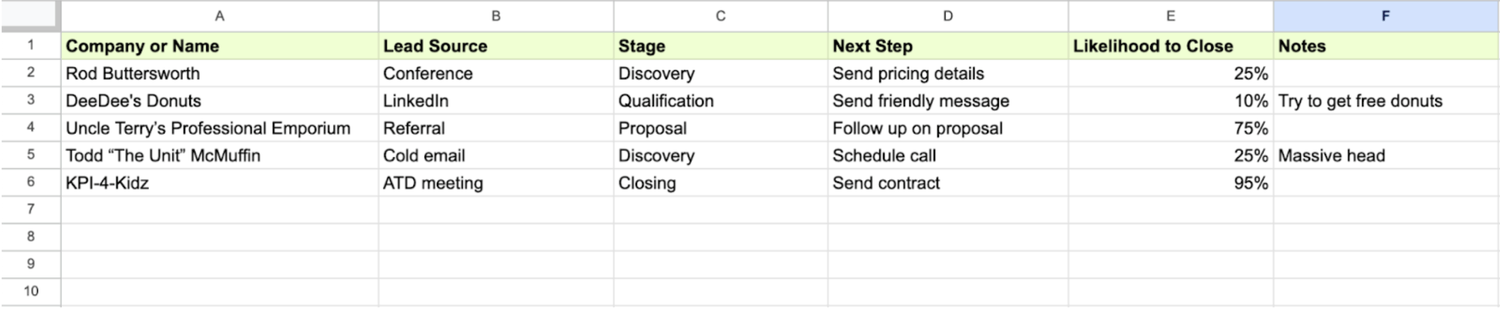
You can grab a copy of our simple sales pipeline template right here! Feel free to customize it and truly make it your own! (This is linked inside the course!)
Ok! We're cutting you off. That's all of Module 11 we can share.

OK. Now What?
Hopefully, you dug that sneak peek of Week 11 of FEAST, and it gave you a bit more of an idea of whether the program might be a fit for you. 2026 Enrollment is now closed. Add your name to the FEAST 2027 Waitlist to catch the next mission to the Instructional Design Space Station.